
Staff Writer
The Vice President and Minister of Finance Ndaba Gaolathe has challenged Botswana to redefine the role of mining, arguing that the country’s mineral wealth should become the foundation of a diversified economy rather than an end in itself.
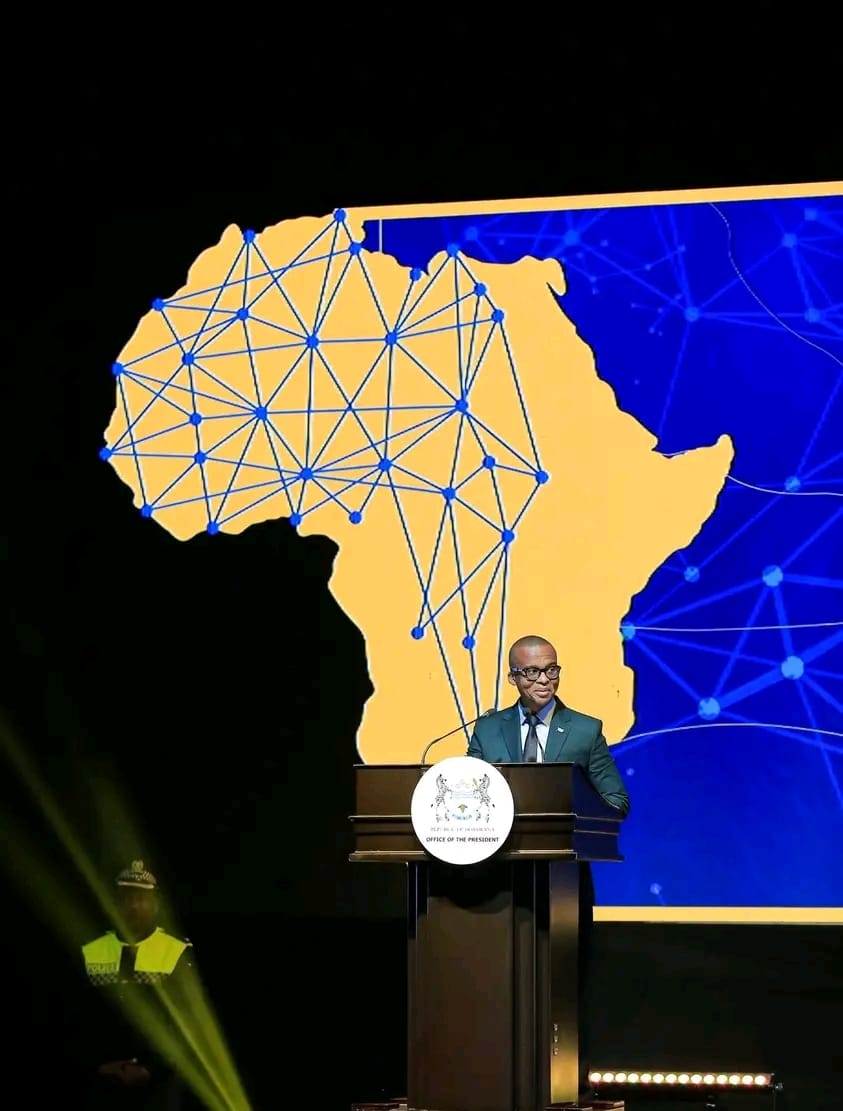
Giving a keynote address at the Future of Mining Summit held in Gaborone on Monday morning, Gaolathe called for a fundamental shift in Botswana’s economic development model, declaring that the country’s future prosperity will not be determined by the minerals it extracts but by what it builds from them.
Gaolathe said Botswana stood at a defining moment similar to the one its founding leaders faced at Independence. While diamonds transformed the country into one of Africa’s leading development success stories, he argued that the next chapter demands a broader, more diversified economy capable of thriving long after mineral resources are depleted.
Gaolathe stressed that at the moment it was no longer about asking whether diamonds transformed Botswana as they unquestionably did.
He said the current question was as to whether the prosperity created by Botswana’s mining sector can become the foundation of an economy capable of thriving long after the last diamond has been mined.
In highlighting the importance of mining, the Vice President paid tribute to Botswana’s founding leaders, crediting their prudent management of mineral wealth for avoiding the so-called “resource curse” that has afflicted many resource-rich nations. However, instead of fuelling conflict, he said, diamond revenues financed schools, hospitals, roads, and strong public institutions.
Since commercial mining began in 1971, Botswana has produced more than 700 million carats of diamonds, helping propel the country from one of the world’s poorest nations to upper-middle-income status within four decades.
However, Gaolathe acknowledged that Botswana’s development momentum has slowed in recent years. He pointed to governance shortcomings, weakening institutional effectiveness and slower economic transformation as evidence that the country can not rely indefinitely on its past achievements.
Rather than abandoning mining, he argued that Botswana must leverage the sector as a catalyst for industrialisation and innovation.
“Our ambition is not to move away from mining. Our ambition is to move further because of mining,” he said, emphasising that the industry must evolve from being the backbone of the economy into the engine that powers broader economic diversification.
Key to this vision is the Botswana Economic Transformation Programme (BETP), which Gaolathe described as the government’s blueprint for implementing the country’s economic reforms.
He noted that nearly 7,000 ideas were submitted by citizens, businesses, and institutions during consultations, from which 186 priority projects were selected. These projects span mining, manufacturing, agriculture, tourism, financial services, infrastructure, and digitalisation while also strengthening education, healthcare, and social protection.
If successfully implemented, the programme could mobilise more than P500 billion in investment and create over 500,000 jobs by 2036, positioning Botswana as a high-income, export-oriented and innovation-driven economy.
Gaolathe stressed that economic transformation would require closer integration between sectors rather than isolated development initiatives.
To that end, he argued that mining should stimulate local manufacturing, engineering, logistics, research, financial services and technology development instead of remaining an enclave industry focused solely on mineral exports.
“Every mine should become the nucleus of a wider industrial ecosystem,” he said, adding that Botswana’s true mining wealth lies in the industries and capabilities created above ground rather than underground.
Further, he stressed more on beneficiation while acknowledging that many countries have struggled to establish successful downstream industries.
In addition, Gaolathe said Botswana intends to avoid those mistakes by simultaneously investing in reliable electricity, transport infrastructure, skilled labour, and financing.
Thus, he noted that mining companies currently import most of their operational inputs while exporting minerals with minimal local value addition. Capturing those supply chains domestically, he argued, presents one of Botswana’s biggest economic opportunities.
The vice president also highlighted growing global demand for strategic minerals such as copper, nickel and manganese as countries accelerate the transition towards cleaner energy and advanced manufacturing.
He said Botswana is well positioned to become not only a reliable supplier of critical minerals but also a destination for value addition and long-term industrial investment.
Appealing to investors, he underscored Botswana’s political stability, sound macroeconomic management, rule of law, and strong institutions as key competitive advantages.
He pledged that the government would continue creating a predictable investment environment built on delivery, certainty, and partnership.
The summit, which continues to grow in leaps and bounds, is now on its i third instalment of the The Future of Mining Summit attracts high profile stakeholders like attracts mining experts, businesses, government, and other developmental partners.
The summit will conclude on 30th June 2026.