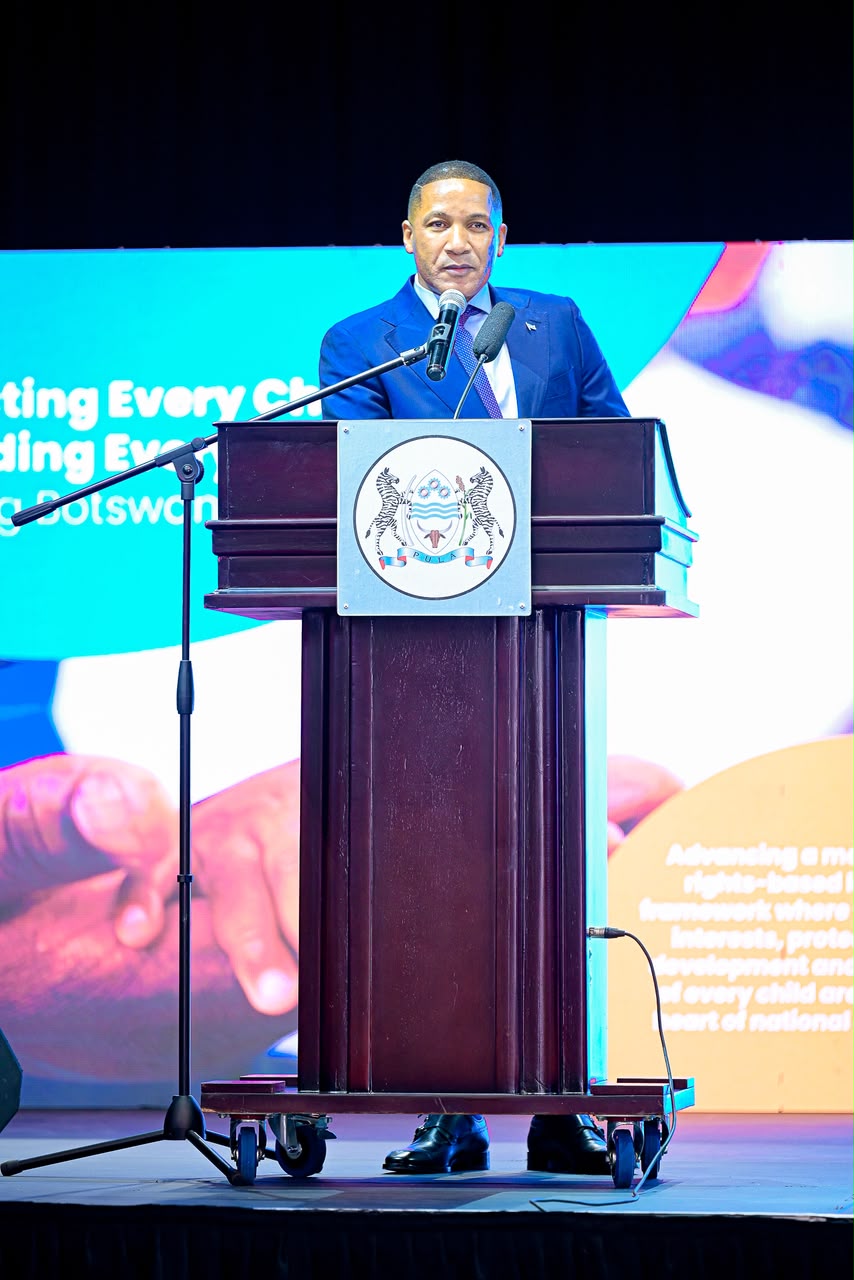

Expanding on his broad vision for child protection and social justice, President Duma Boko has called for a national debate on the fundamental legal and physical definition of a “school,” arguing that socio-economic status must never dictate the quality of learning infrastructure or basic welfare provided to children in Botswana.
Speaking during his masterclass address, the President shifted focus to socio-economic rights, urging the nation to establish and enforce clear minimum standards for educational facilities and nutritional support.
Rethinking What Constitutes a “School”
President Boko challenged existing disparities in educational infrastructure, asserting that the term “school” cannot merely refer to four walls and a roof, but must guarantee a dignifying environment equipped with baseline facilities regardless of geographic or economic setting.
He emphasized that children from lower-income backgrounds are entitled to the exact same structural, technological, and sanitary standards as those attending elite institutions. According to the President, failing to guarantee these uniform standards perpetuates systemic inequality and undermines the constitutional dignity of the child.
The Role of the Judiciary and Constitutional Enforcement
Highlighting the critical role of the courts in upholding fundamental social rights, President Boko noted that the judiciary—and a potential specialized Constitutional Court—must serve as an active guarantor of baseline standards in public education and child nutrition.
To illustrate how constitutional jurisprudence can safeguard child welfare beyond traditional boundaries, the President cited landmark litigation from South Africa’s Constitutional Court regarding national school nutrition programs. In that jurisprudence, the court ruled that the state’s obligation to feed vulnerable schoolchildren extended even during school holiday periods when facilities were closed, recognizing that a child’s right to basic nutrition does not pause during academic breaks.
A Holistic Framework for Child Rights
By linking infrastructure, nutrition, and judicial enforcement to the broader legal framework of child protection, President Boko reaffirmed that true legislative reform must encompass both protective laws and enforceable socio-economic guarantees.
His remarks set the stage for upcoming policy debates on education reform, signal-boosting the necessity for enforceable statutory standards that protect every child’s right to quality education and basic sustenance across Botswana.