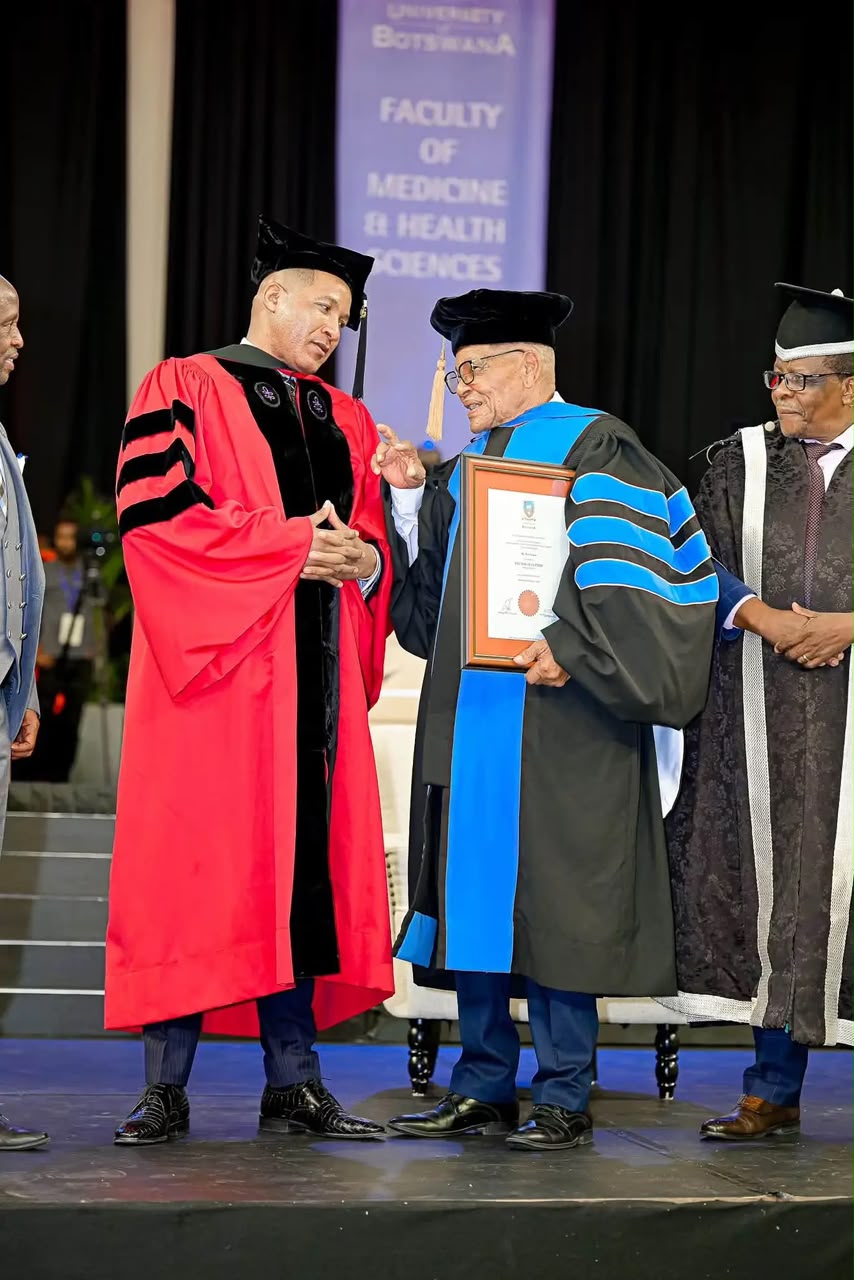

Indigenous rights activist Roy Sesana has been conferred an honorary Doctor of Letters (Honoris Causa) by the University of Botswana. The ceremony, attended by President Advocate Duma Boko, celebrated a lifetime spent defending the rights, heritage, and ancestral lands of the San people of the Central Kalahari Game Reserve (CKGR).
For decades, Sesana’s life was defined by intense legal and political resistance against the state. His recognition marks a profound shift from decades of marginalisation toward national validation of Indigenous rights.
A Lifetime of Resistance and Advocacy
Born on September 17, 1929, in Molapo, deep within the CKGR, Roy Sesana grew up rooted in the traditional hunter-gatherer lifestyle of the San. In 1991, as government pressures to relocate Indigenous communities from the reserve mounted, Sesana co-founded First People of the Kalahari (FPK). Assuming the leadership of FPK in 1995, he became the foremost voice opposing the state’s efforts to remove San communities from their ancestral homeland.
The confrontation escalated dramatically between 1997 and 2002, when the government systematically dismantled essential services inside the CKGR—cutting off water supplies, closing health posts, and terminating food rations in an attempt to force relocation to resettlement camps such as New Xade and Kaudwane.
Refusing to abandon their ancestral soil, Sesana and his fellow activists took the state to court in what became the longest and most expensive legal battle in Botswana’s history (Roy Sesana and Others v. The Attorney General).
The Legal Battle and the Bond with Duma Boko
During these arduous legal trials, legal advocacy played a critical role in championing the rights of the San community. Among the legal minds who stood beside the CKGR residents across years of litigation was human rights lawyer Advocate Duma Gideon Boko—who now serves as the President of Botswana.
Advocate Boko represented the San in multiple court proceedings linked to the aftermath of the 2006 High Court judgment. The landmark 2006 ruling declared that the government’s eviction of the San was unlawful and unconstitutional, affirming their constitutional right to reside on their ancestral lands. In subsequent legal battles, including disputes over access to water boreholes and rights of return for descendants, Boko consistently defended the San in court against state overreach.
Sesana’s unwavering international campaign earned him the prestigious Right Livelihood Award (often referred to as the “Alternative Nobel Prize”) in 2005.
From Persecution to Presidential Honor
The presence of President Duma Boko at the University of Botswana graduation ceremony highlighted the journey both men have taken—from opposing state policy in courtroom battles to shaping the country’s future at the highest levels of governance.
Now officially holding the title of Dr Roy Sesana, the veteran activist continues to advocate for sustainable community development, land zoning rights, and essential service access for San communities. While challenges around land rights and economic integration persist, the conferment of this doctorate signals an important national acknowledgment of the San people’s enduring heritage and rights