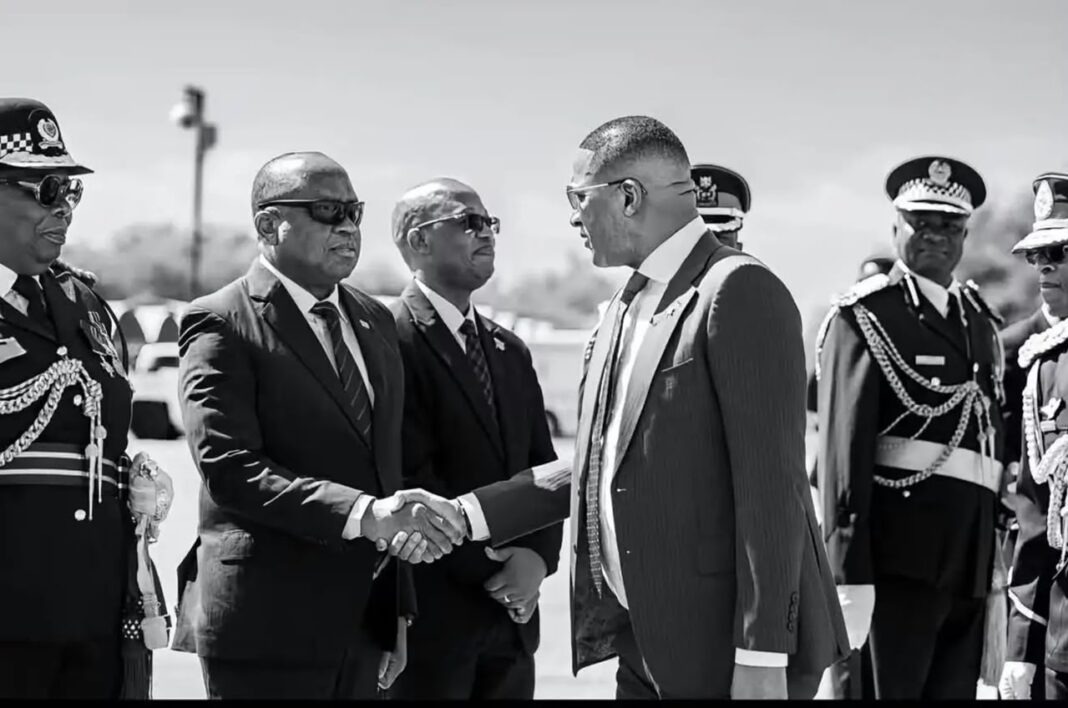

During the State of the Nation Address, President Duma Boko confirmed the appointment of Professor Lekoko Kenosi as the substantive Director General of the Directorate on Intelligence and Security. The declaration formalizes an immediate transition at the apex of Botswana’s state security apparatus, concluding an interim leadership period that followed the retirement of Brigadier Peter Magosi. His stint as Botswana’s Ambassador to the People’s Republic of China has concluded and Kenosi has returned to Gaborone and officially assumed duty at the agency’s headquarters today.
His elevation represents a historic departure from the orthodox military command archetypes that have dominated the directorate since its inception. While past commanders entered the office through conventional tactical and combat pipelines, Kenosi arrives as a scholar-diplomat whose career bridges civil-military relations, international statecraft, and information architecture. His background reflects a deliberate pivot toward an intellect-led, reformist security doctrine designed to harmonize intelligence operations with constitutional democracy.
Kenosi’s academic engagement with the security establishment has long focused on the delicate intersection of defense institutions, democratic legitimacy, and civil oversight. In his foundational security study analyzing the Botswana Defence Force and public trust, Kenosi argued that armed forces in a constitutional democracy depend fundamentally on public confidence for their legitimacy. He cautioned that a military or security agency that fails to cultivate public trust will perpetually struggle to justify its authority and existence, establishing a doctrinal belief in transparency and institutional integrity that directly informs his arrival at an agency historically shadowed by public suspicion.
Beyond civil-military theory, Kenosi is internationally regarded as a leading authority on security records management, official secrecy, and state accountability. Holding a doctorate in archival and information science, he has produced extensive scholarship examining the tension between state secrecy doctrines and democratic oversight in an age of asymmetric digital threats. His research has scrutinized how security institutions handle, preserve, or unlawfully destroy sensitive operational archives, with his work on post-apartheid South Africa’s Truth and Reconciliation Commission demonstrating how security records can either entrench impunity or foster national reconciliation. His domestic scholarship also encompasses direct empirical evaluations of judicial workflows and evidentiary integrity within the Gaborone Magisterial District.
Kenosi’s intellectual pedigree is reinforced by senior institutional appointments across Africa and the Middle East. He built and directed core archival and records infrastructures as University Archivist at Zayed University in Abu Dhabi, served as Head of Archives at the Qatar Foundation and Qatar National Library, and established foundational records systems at the King Abdullah University of Science and Technology in Saudi Arabia. These appointments, alongside his long-standing academic links with the University of Botswana and regional bodies like the Eastern and Southern Africa Regional Branch of the International Council on Archives, established him as a premier architect of institutional memory and data governance.
Complementing this scholastic depth is Kenosi’s recent diplomatic service in Beijing, where he represented Botswana’s strategic interests in one of the world’s primary geopolitical epicenters. Navigating bilateral trade negotiations, technological cooperation, and infrastructure statecraft in China provided him firsthand exposure to global intelligence environments, foreign policy dynamics, and modern cyber capabilities. This international vantage point provides the directorate with a much-needed external lens, sharpening Botswana’s ability to analyze foreign espionage, safeguard economic sovereignty, and evaluate evolving security developments within the Southern African Development Community.
Kenosi steps into office facing the immediate mandate of restoring institutional credibility and depoliticizing the agency’s operations. Long scrutinized over domestic surveillance and political entanglements, the directorate is now under the stewardship of a thinker whose entire body of work advocates for statutory compliance, institutional checks, and public trust. Furthermore, as national security threats increasingly pivot toward cyber warfare, financial crimes, and disinformation, Kenosi’s sophisticated mastery of digital information systems equips the state to move away from brute-force surveillance toward high-level analytical intelligence. His appointment signals a new chapter for the Directorate on Intelligence and Security, establishing an administration rooted in scholarly rigor, global diplomatic awareness, and constitutional governance.